
Could be minutes, could be hours—for how long you have been travelling, you cannot tell. Time bends and expands whimsically when one is traversing the winding trails of the World Wide Web.
At last you come to a door, guarding not a house, not a building of any kind. Just a wooden door, standing upright in the blackness like a post amidst the ocean. It seems locked; but when you knock on its rough surface, it swings open without the faintest sound.
At the other side, you find an impossible room, its walls lined with yellowed notes and connecting threads of bright red: a story with seemingly no beginning and no end. The work of either a madman—or a genius.
Sitting among the chaos, half buried behind a pile of paper sheets that sit on top of an almost engulfed desk, its creator. A thin, middle-aged man, with dark circles around his tired eyes. Mumbling to himself while scribbling fiercely on a piece of scrap paper, oblivious of your presence.
Then the man lifts his gaze with a start and fixes his greenish-brown irises upon you.
“You have been travelling, haven’t you?” he says. His voice rasps, as if he hadn’t used it in a long time. “Then you must be one of the few that dare to venture out there. Therefore you have my respect. Welcome to my dwelling.”
“What… are you doing here?” you mutter.
“I put on paper the rogue stories that wander the void. Trap them, so to speak. Then, by developing all the logical paths they can take, I end up with a game. Sometimes I craft single-path narratives—that is, when an idea is so appealing that I wish to focus only on it, and bring it to the last consequences.”
“So you are a narrator?”
“One can say so. Sometimes I also venture into other endeavours, but I always give my work a dense narrative background. Narrative! That’s the beat of a story. Strip the narrative out of it… and you’ll end up just with numbers.”
Ask the narrator to show you:
NARRATIVE GAMES
Fog – The White Darkness
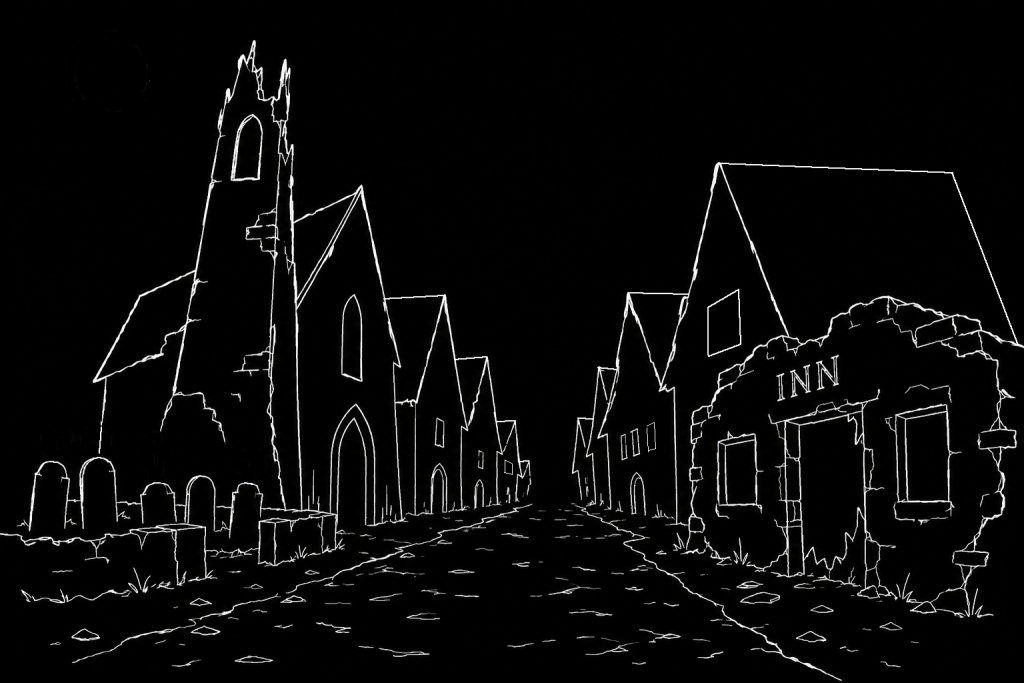
The idea for Fog — The White Darkness stemmed from a brief holiday in the Val d’Aran, a remote valley in the northwestern corner of Catalonia. There the air is chill and the nights are cold, even in summer, and the settlements are few and sparsely populated—villages of scattered houses with ragged slate roofs, rough stone walls, and winding, steep streets.
That desolate landscape planted a seed in my mind: the need to write a game in which civilization falls away, leaving only atavistic, primordial fear and superstition as the sole line of defense when night falls and nature becomes a hostile, lurking entity beyond the glare of the bonfire. In this game the player would take on a character who must face forces that escape their comprehension and challenge their most deeply rooted beliefs.
The result is a story of roughly 80 sections and four endings (two victories, two deaths), consisting of three main acts, without the possibility of backtracking between them. Each act branches enough to give the player a fair degree of freedom—within the limits of what 80 sections allow.
Fog was first written in Spanish and entered the III Interactive Fiction Contest organized by the online role-playing community Comunidad Umbría, where it was awarded second prize. Afterwards I reworked the implementation on a small custom engine I built in Python, and translated the game into English.
Here you can watch (in Spanish) the evaluation of the jury for the III Interactive Fiction Contest on Fog, and here, the verdict.
The narrative flowchart is available below.
To download and play the game, click on the button below.
Astrayed
Here’s a question for all the gamebook aficionados out there: have you ever felt that a single, extremely unlikely die roll completely shattered the narrative of this amazing game you were playing? In other words, have you ever felt that you made the right choice, that your character—highly skilled in that particular discipline—should have succeeded in that trivial action, but the dice said otherwise?
Don’t get me wrong. I love character stats and point allocation. They are a cool way to make a character your character. However, dice are unmerciful creatures and if you throw them long enough, misfortune will happen. A system was needed: one that kept all the enjoyable maths of character stats but ruled out the pitfalls of dice rolling. And so came Astrayed.
Astrayed—from astra (star) and strayed—is an open-world gamebook set in a science-fiction landscape—not because I wanted to write a tech-dense story, but simply because this setting felt like the one that gave me the most freedom for worldbuilding—with a totally blank Player Character: no gender, no description whatsoever. Just a tabula rasa ready for the player to pick up the chisel.
I started drafting with a clear idea of the system, a vague sense of how the narrative should unfold, and a plan to keep the game small—confined to a maximum of 100–150 sections of text. However, after some time I realized the system I’d devised wouldn’t work in a small game. It had to be BIG. So I kept branching until I ended up with roughly 1,000 sections of text.
That’s why Astrayed is still a work in progress.
But you can try a vertical slice on the pdf below.
For more information and downloadable content, check the itch.io page by clicking the button below.
The Heart of the Mountain
I remember that Christmas back in the ’90s when I unwrapped a mysterious game packed with plastic miniatures and cardboard furniture (yes, HeroQuest!). It was the first time I faced a game that offered not just mechanics, but also deep lore. And I was amazed by it.
Later on, adulthood struck, and those fancy miniatures were no longer enough to fool my cynical adult eye. The charm faded the moment I realized the quests were little more than hack-and-slash raids with a bit of inventory management on the side.
So I grabbed a notebook and started drafting The Heart of the Mountain: a dungeon crawler that combines all the cool things about dungeon exploration with a thick narrative layer. The game takes place in a world that blends dieselpunk with traditional medieval fantasy, where three factions—elemental wizards, southern druids, and diesel technocrats—coexist in tense equilibrium. That fragile balance is suddenly threatened by the discovery of a giant sanguine crystal, a rare gem capable of disrupting the established order.
The Heart of the Mountain features a five-level, reactive dungeon with a complementary narrative structure: each Player Character experiences the game differently and discovers unique narrative paths, causing the story to unfold differently.
The script of the cinematic introduction of the game plus one of the three playable cutscenes that follow is available in the pdf below.
For now, the game is a text-based prototype written in Catalan, featuring two levels and one of the three Player Characters, but I intend to turn it into a fully fledged 3D dungeon crawler with the option to play it in English.
To play the prototype and access extra downloadable content, check the itch.io page by clicking the button below.
SHORT FICTION
Sally
Sally is a sci-fi short story published in Catalan in Catarsi magazine, issue 20. It reflects on the line we draw between what we consider a sentient being and what we do not, and on how falling into one category or the other determines the way we treat a species. What if we have drawn that line in the wrong place?
You can read it in English below. The Catalan version is available here.
Reading time: 12 min.
The Watcher
The Watcher is a folk-horror short story, first published in Catalan in Catarsi magazine issue 16 and later included in my short story collection Històries limítrofes. Set in a fictional Pyrenean village, it addresses the question of whether the passing of a loved one should be delayed indefinitely, whatever the cost—or whether, at some point, it is best to let them go.
The story is available below. The Catalan version is available here.
Reading time: 20 min.
OTHER GAMES
Mine Madness
In a late 19th-century American West infused with fantasy elements, a team of three brave adventurers led by Ellen Sawyer enters an abandoned mine whose depths are said to hold inconceivable riches, with the only goal to collect every gem they can carry. Alongside cunning Sawyer, the team includes the more-than-capable engineer and expert in explosives Henry Hawkins, and Crusher Jane, a blacksmith of imposing physical strength.
The game started as a small side project but grew into something worthwhile. Although not an RPG per se, it aims to quench the thirst of all genre enthusiasts who lack the time for complex titles.
Technically, it’s a turn-based endless roguelike, but it includes typical CRPG elements like tactical team-based combat, characters with distinct stats and abilities, inventory management, and character progression. Each Player Character has a distinctive skill set that reflects their personality. Also, the game features original monsters of my own making, such as:
CLAWJAW: a dreadful myriapod of astonishing strength, able to shatter rock with its jaws. It will chase you relentlessly.
BLACK DEATH: don’t let this insect’s small size fool you—its bite is the most lethal of its kind. Avoid it at any cost.
BLIND LIZARD: underground life has deprived this humanoid lizard breed of their sight. Don’t let them find you—their teeth are razor-sharp.
GROWL: a creature of pure anger and brute force. The echo of its growl bouncing off the tunnel walls makes the bravest shiver.
Welcome to the underground madness.